Best Pillows for Every Sleep Position: A Complete Guide
Find your perfect pillow match based on how you sleep. Learn which pillow types and lofts work best for side, back, and stomach sleepers.
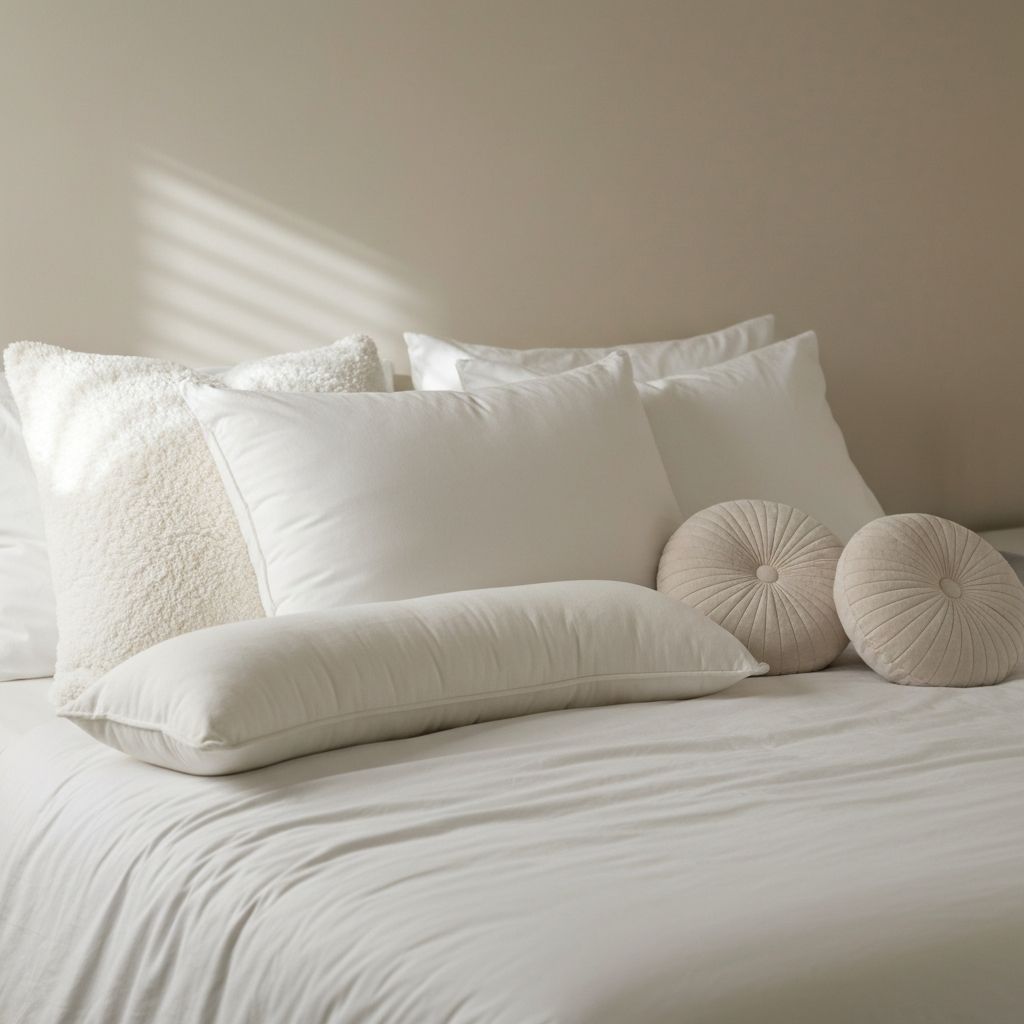
The right pillow does more than provide a soft place to rest your head. It maintains proper alignment between your neck and spine, prevents morning stiffness, and contributes significantly to overall sleep quality. Yet many people give little thought to pillow selection, using whatever came with their bedding set or grabbing the cheapest option available.
Understanding how pillow characteristics interact with your sleep position helps you make choices that support better rest and physical comfort.
Why Pillow Choice Matters
Your pillow's primary job is maintaining neutral spinal alignment, keeping your neck neither flexed upward nor bent downward during sleep. When alignment is off, muscles must work to compensate, leading to tension, stiffness, and poor sleep quality.
The ideal pillow fills the gap between your head and mattress while supporting your neck's natural curve. This optimal fill varies significantly based on sleep position, body size, and mattress firmness.
Pillows for Side Sleepers
Side sleeping is the most common sleep position, and it requires the most pillow support to maintain alignment. When lying on your side, the gap between your head and the mattress is substantial, requiring a pillow with enough height (loft) to fill this space.
Ideal Characteristics
Higher loft: Side sleepers typically need pillows 4 to 6 inches thick, though exact needs vary by shoulder width. Broader shoulders require higher loft.
Firmer support: A pillow that compresses too easily will not maintain the height needed throughout the night.
Gusseted design: Pillows with gussets (side panels) often maintain their loft better than flat pillows.
Best Pillow Types for Side Sleepers
Memory foam: Provides consistent support and fills the neck gap well. Contoured options can offer additional neck support.
Latex: Offers responsive support with good durability. Maintains loft better than many alternatives.
Firm down or down alternative: High-fill-power down pillows can provide adequate loft if sufficiently filled.
Additional Tips
Consider placing a pillow between your knees while side sleeping. This reduces stress on hips and lower back by keeping the spine aligned from top to bottom.
Pillows for Back Sleepers
Back sleeping creates a smaller gap between head and mattress, requiring less pillow height. The primary concern is supporting the natural curve of the cervical spine without pushing the head too far forward.
Ideal Characteristics
Medium loft: Back sleepers typically need pillows 3 to 5 inches thick. The pillow should fill the neck curve without tilting the head upward.
Medium firmness: Enough support to maintain position but not so firm that it pushes the head forward.
Contouring ability: Some contouring helps support the neck curve without creating pressure points.
Best Pillow Types for Back Sleepers
Contoured memory foam: Designed with a wave shape that supports the neck while cradling the head. Many back sleepers find these particularly comfortable.
Shredded foam or adjustable fill: Allows customization of loft and support to find optimal height.
Medium-fill down or down alternative: Provides contouring support without excessive height.
Watch for These Issues
A pillow that is too high will push the head forward, straining the neck. A pillow that is too flat may allow the head to fall back, also creating strain. The goal is neutral alignment where the head rests in line with the spine.
Pillows for Stomach Sleepers
Stomach sleeping presents the greatest challenges for spinal alignment, and pillow choice can either help or worsen the inherent issues of this position. When sleeping face-down, even a moderately thick pillow can push the head back, straining the neck.
Ideal Characteristics
Very low loft: Stomach sleepers need the thinnest pillows, typically 3 inches or less. Some stomach sleepers sleep best with no pillow at all.
Soft and compressible: A pillow that flattens easily prevents neck extension.
Slim profile: Look for pillows specifically designed for stomach sleepers.
Best Pillow Types for Stomach Sleepers
Soft down or down alternative: Compresses easily to minimal height while still providing some cushioning.
Thin memory foam: Provides slight cushioning without excessive lift.
Buckwheat (partially filled): Can be adjusted to very low heights and shaped as needed.
Consider a Body Pillow
Placing a body pillow or regular pillow under the hips and stomach can help reduce lower back strain associated with stomach sleeping by keeping the spine more neutral.
Pillows for Combination Sleepers
If you change positions throughout the night, pillow selection becomes more complicated. No single pillow optimally serves all positions, but some options accommodate multiple sleeping styles better than others.
Strategies for Combination Sleepers
Medium loft and firmness: Compromise settings that work reasonably well across positions.
Adjustable pillows: Shredded foam or buckwheat pillows that can be shaped and adjusted as you change positions.
Multiple pillows: Some combination sleepers use different pillows or stack pillows differently depending on their current position.
Pillow Materials Compared
Beyond loft and firmness, pillow materials affect feel, durability, temperature, and maintenance.
Memory Foam
Pros: Consistent support, pressure relief, maintains shape well, hypoallergenic. Cons: Can retain heat, may have initial odor, heavier, cannot be machine washed.
Latex
Pros: Responsive support, naturally cooling, durable, hypoallergenic, resistant to dust mites. Cons: Higher price, heavier weight, may feel too bouncy for some.
Down and Feathers
Pros: Soft and moldable, lightweight, breathable, long-lasting if cared for properly. Cons: Requires regular fluffing, may trigger allergies, loses loft over time, not vegan.
Down Alternative
Pros: Mimics down feel at lower cost, hypoallergenic, machine washable, vegan. Cons: May not last as long as quality down, can clump over time.
Buckwheat
Pros: Adjustable, supportive, naturally cooling, long-lasting. Cons: Heavier, makes rustling sound when moving, different feel than traditional pillows.
When to Replace Your Pillow
Pillows do not last forever. Signs that indicate replacement time include visible lumps or flat spots, persistent odors that do not wash out, waking with neck pain or stiffness, and needing to fold the pillow in half to get support. Most pillows should be replaced every one to two years, though quality latex and buckwheat pillows can last longer.
Finding the right pillow for your sleep position transforms sleep quality in ways that often surprise people. Taking time to select an appropriate pillow is one of the simplest ways to improve your nightly rest.
Tags
Written by
Sarah Mitchell
A contributing writer at SleepWell Daily. Our team is dedicated to providing well-researched, accurate, and helpful content to our readers.
Learn more about our teamRelated Articles
How to Choose the Right Mattress: A Complete Buying Guide
Navigate the mattress market with confidence using our comprehensive guide to mattress types, firmness levels, and features that matter most.

Sleep Tracker Guide: What They Measure and How Accurate They Are
Understand how consumer sleep trackers work, what they can and cannot tell you, and how to use this data to improve your sleep.
Weighted Blankets: Benefits, Science, and How to Choose
Explore the research behind weighted blankets, understand who benefits most, and learn how to select the right weight and material for your needs.