Meditation for Sleep: Techniques That Actually Work
Learn evidence-based meditation techniques specifically designed to help you fall asleep faster and sleep more deeply, from body scans to guided imagery.
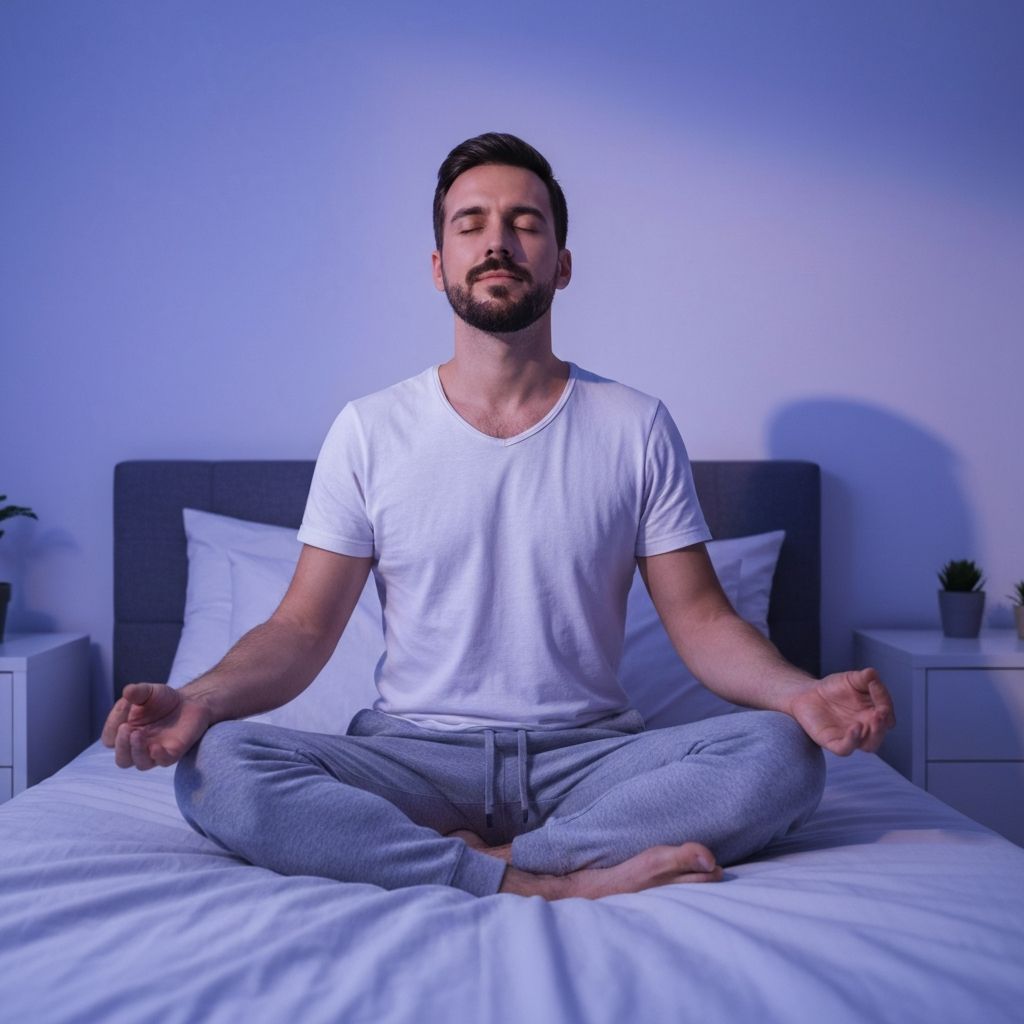
Racing thoughts at bedtime are one of the most common barriers to falling asleep. Meditation offers a proven way to quiet the mind and prepare your body for rest. This guide covers specific techniques designed for sleep, backed by research and practical enough to use tonight.
Why Meditation Helps Sleep
Meditation works on multiple pathways that affect sleep:
Reduces Activation
The relaxation response triggered by meditation lowers heart rate, blood pressure, and stress hormones—all of which need to decrease for sleep onset.
Quiets the Mind
Meditation trains attention, helping you disengage from the worrying thoughts that keep you awake.
Shifts Brain Waves
Meditation increases alpha and theta brain waves associated with relaxation and the transition to sleep.
Builds Long-Term Benefits
Regular meditators show improved sleep quality overall, not just on nights they meditate.
Technique 1: Body Scan Meditation
The body scan systematically relaxes each part of your body while directing attention away from thoughts.
How to Practice
- Lie in bed in your normal sleep position
- Take three deep breaths, exhaling slowly
- Focus attention on your feet—notice any sensations
- Consciously relax your feet, imagining tension melting away
- Move attention slowly up through your legs, hips, torso, arms, and head
- If your mind wanders, gently return to where you left off
- After completing the scan, rest in full-body awareness
Tips for Success
- Spend 20-30 seconds on each body part
- Don't worry about "doing it right"
- If you fall asleep before finishing, that's the goal
- Practice the same sequence each night to build a sleep association
Technique 2: 4-7-8 Breathing
This breathing pattern, developed by Dr. Andrew Weil, acts as a natural tranquilizer for the nervous system.
The Pattern
- Exhale completely through your mouth
- Inhale quietly through your nose for 4 counts
- Hold your breath for 7 counts
- Exhale completely through your mouth for 8 counts
- Repeat the cycle 3-4 times
Why It Works
The extended exhale activates the parasympathetic nervous system, triggering relaxation. The held breath allows oxygen to saturate your bloodstream, promoting calm.
Building the Practice
Start with just 2-3 cycles if the holds feel difficult. With practice, you'll be able to extend comfortably.
Technique 3: Guided Imagery
Guided imagery uses visualization to create a mental environment conducive to sleep.
Self-Guided Approach
- Close your eyes and imagine a peaceful place—a beach, forest, mountain cabin
- Build the scene in detail: What do you see? Hear? Smell?
- Imagine yourself there, completely relaxed and safe
- Continue adding sensory details until you drift off
Using Recordings
Many apps and recordings offer sleep-specific guided imagery. The narrator's voice becomes an anchor for attention, pulling you away from anxious thoughts.
Tips for Imagery
- Choose calming, not exciting scenes
- Return to the same scene each night for faster relaxation
- If intrusive thoughts appear, acknowledge them and return to your scene
- Incorporate feeling states—imagine feeling peaceful, heavy, drowsy
Technique 4: Counting Meditations
Simple counting techniques occupy the thinking mind just enough to prevent racing thoughts while being boring enough to promote sleep.
Basic Counting
Count backward slowly from 300. The monotony occupies your mind without stimulating it.
Breath Counting
Count each exhale, 1 through 10, then start over. When you lose count (and you will), simply start again at 1.
Visualization Counting
Combine counting with imagery—imagine writing each number on a chalkboard, then erasing it, or watching numbered sheep jump over a fence.
Technique 5: Progressive Muscle Relaxation
PMR alternates between tensing and relaxing muscle groups, creating deep physical relaxation.
The Process
- Starting with your feet, tense the muscles firmly for 5 seconds
- Release suddenly and completely
- Notice the contrast between tension and relaxation
- Rest for 15-20 seconds
- Move to the next muscle group (calves, thighs, etc.)
- Progress through the entire body
Modified for Sleep
For sleep, you can use relaxation-only PMR—simply directing relaxation to each muscle group without the tension phase, which some find too activating at bedtime.
Common Obstacles and Solutions
"My mind won't stop"
This is normal, especially at first. The goal isn't to stop thoughts but to relate to them differently. Notice them, then return to your technique.
"I can't concentrate"
You don't need perfect concentration. Even a few moments of focused attention, repeated many times, creates the relaxation response.
"It's not working"
Give any technique at least two weeks of consistent practice before evaluating. Many people experience benefits gradually rather than immediately.
"I fall asleep during meditation"
At bedtime, this is exactly what you want. Don't worry about "proper" meditation form when the goal is sleep.
Building a Sleep Meditation Practice
Consistency Matters
Practice at the same time each night to build association between meditation and sleep.
Keep It Simple
Choose one or two techniques that resonate with you rather than trying everything.
Manage Expectations
Some nights will be easier than others. The practice builds over time.
Consider Apps
Sleep meditation apps like Calm, Headspace, and Insight Timer offer guided options if self-directing feels difficult.
The Bottom Line
Meditation for sleep works by calming the nervous system and redirecting attention away from the thoughts that keep you awake. While it may take practice to feel comfortable with these techniques, most people find that consistent meditation significantly improves their ability to fall asleep and stay asleep. Start with one technique tonight—your body and mind are capable of learning to relax on cue.
Tags
Written by
Sarah Mitchell
A contributing writer at SleepWell Daily. Our team is dedicated to providing well-researched, accurate, and helpful content to our readers.
Learn more about our teamRelated Articles
Relaxation Techniques for Better Sleep: Evidence-Based Methods
Learn proven relaxation techniques including progressive muscle relaxation, deep breathing, and visualization to calm your mind and body before bed.

Breaking the Stress-Sleep Cycle: How to Rest When Worried
Understand the bidirectional relationship between stress and sleep, and learn strategies to break the cycle and achieve restorative rest.

Sleep and Exercise Recovery: How Rest Rebuilds Your Body
Discover the critical role sleep plays in athletic recovery, muscle repair, and performance improvement for everyone from casual exercisers to serious athletes.